
Meet our Director of Studies
‘The feeling I get is that we are small, but we are mighty.’
Flora Gibbons, Heywood Prep’s Director of Studies is reflecting on the school she has helped to develop over the past two years. The school may be small, she explains, but the framework of the learning here gives staff the ability to create a genuinely tailored educational experience for each child. Much of this is shaped by part of the work Flora does, drawing on data, alongside her knowledge of the children in the classroom, to identify a child’s specific capabilities and potential, to help shape learning plans for both gifted children and those who may struggle in one subject or another, and to evidence progression and success. A technical approach which supports everything else Heywood does in a very practical way.
When Flora joined Heywood two years ago, she brought a wide variety of experience of nearly two decades that has helped with Heywood’s academic development. The majority of her career was at a top London independent school, where she had been a Year 4 and 6 form teacher, had responsibility for pupil progress, and managed newly qualified teachers. She had worked with young people who missed out on learning during Covid to support them with standardised tests, enjoying the challenge of working with children who had had interrupted education for a number of reasons. She has also had much experience tutoring children in preparation for the 11+ and 13+ assessments, and offering interview practice.
Arriving at Heywood Prep in the summer term of 2024, it was, she says, an exciting time to join. Head Tim O’Connell had only been in role for one term, and he was quick to put her experience to good use. She started applying her skills and experience with data, alongside classroom observation and teacher insight, using it to identify children who had unusual potential, as well as those who would benefit from extra support. She introduced formative assessments which allows teachers to evidence what they know a child can achieve in the classroom, not what they can prove to you in a test. ‘Children still need to sit tests, but once you have established their ability under pressure, you can then focus on helping them replicate in a test what you know they can do in the classroom.’
This last point is one that Flora can speak to personally. One of six children, she was the only one who didn’t seem to find education a breeze. ‘My siblings are very academic and were all successful at school. One became a journalist, two became authors, and one was a political aide. I was the only one who found it hard.’ The problem was never about comprehension – she is intelligent, and intellectually curious, no question about that. But regurgitating what she had learned and the ideas that she had developed in the form of essays and exams, simply stumped her. ‘I could talk about it no problem, but I couldn’t get it down on paper. I passed the Cambridge entry interview, but just couldn’t manage the written exam. The narrative was that I was lazy, and I believed it.’
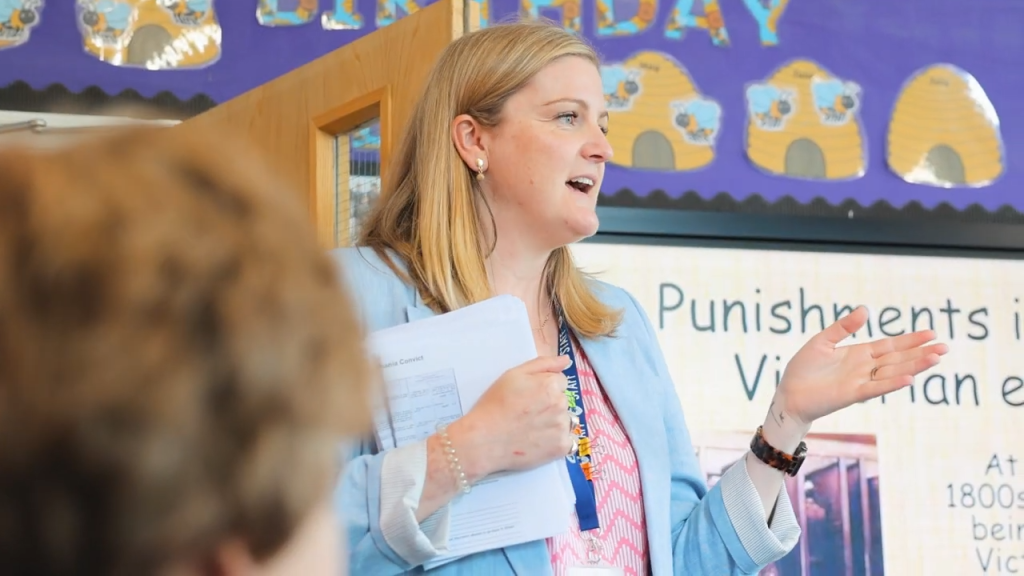
The adult Flora, tasked as she is with academic rigour, takes a different view.
‘I look back and can clearly see that just wasn’t the way for me. At the time, no one was able to show me how to evidence all I had learned. Now I know what I would do if I was faced with me as a pupil. Today, we have different ways for children to communicate what they have learned, that just weren’t there when I was at school.’
I ask why, given that she didn’t enjoy school, she ended up back there professionally. ‘Funnily enough, I’ve always enjoyed teaching, informally as well as formally. The fact that I didn’t have a very nice time at school has just made me a better teacher. I can empathise as well as sympathise.’
That empathy is apparent in the warmth with which she talks about the children. She is committed to finding and tapping into different learning styles, while still maintaining academic ambition for all. There is a rigour to it. This is not some kind of softly softly acceptance that some children will do better than others. It is much more about recognising that abilities may be masked by processing difficulties, and tweaking the delivery of education is what is required to really capitalise on their potential. ‘And that is not telling them to just try harder. There are so many different ways in which we can support children’s learning, and we are always learning new tools and techniques. When I was at school, there were no support groups or booster sessions. There wasn’t a conversation to establish why you found something difficult.’
With her obvious interest in the benefits of creating an education to fit the child, rather than the other way round, it’s no surprise that she loved Heywood’s Individualised Learning programme. Half an hour each day is given over to anything from extra support in a subject the child finds challenging, to academic stretch in something they are finding too easy. And then it introduces opportunities to try new things, such as debating, entrepreneurship, music. ‘ILs are really impressive. Previous schools I had taught in had more classes per year group, and usually these were used to put children in sets. IL allows you to tailor the provision to each child. Children’s feedback is really positive and I can see what benefit it brings.’
Although officially a Science specialist, Flora’s true passions are History and Maths. She delivers three Maths IL sessions for prep-aged children. Maths Masters is designed to stretch and challenge children at a higher level. Maths Fluency helps children to embed times tables, number bonds, and core mathematical methods. Magic Maths provides additional support for children who need a little extra help to build confidence and understanding. She will often use these sessions as an opportunity to pre-teach what is coming up in the following week’s classroom lesson, giving them a head start. ‘We did a session on prime numbers in an IL, so that when it came to the classroom learning on prime numbers, they were already familiar, and it meant they felt good about themselves. They were not playing catch up with the children who could grasp the concept more quickly, and so instead of shutting down and giving up, they felt positive.’
Another part of Flora’s role is to work with Heywood’s talented teaching staff to find ways of extending and developing the quality of teaching. ‘We all have high standards for teaching,’ she says, ‘and I try lead by example. Being Director of Studies, you’d better practise what you preach!’.
She has explored ways to help teachers make Heywood’s ethos of independent learning explicit, developing physical diagrams, models and charts (called Thinking Frames) – tools anyone can use to help them organise thoughts, all as facilitators for creating genuinely enquiry-based learning. The science behind it in brief is that thinking frames help to build more secure neurological pathways and therefore aid the retention and recall of knowledge. ‘To use an analogy, you could liken the brain to a jungle. If you try to make a path the first time, it is difficult and with many obstacles. But the more you walk that path, it will become a permanent feature. Likewise, a neurological pathway is like the jungle path; the more you ‘walk’ it, and the more memorable those ‘walks’ are, then the better chance you have of retaining that knowledge as long term information.’
‘There are many fun ways you can get children thinking for themselves. My Year 6 came into a lesson and on the smartboard I had really zoomed in on a black and white photograph, so it was just a blurred collection of pixels. I didn’t say anything, but they immediately tried to work out what it was. I’d zoom out bit by bit, and they would say, ‘Oh, I can see a cross,’ and then, ‘I can see medals. It’s a soldier.’ We go out a bit further, and then, ‘Actually, it’s a dog!’ Which obviously had them asking questions, and they discovered this was a dog called Stubby who was awarded medals in WW1. It took three minutes, and all it required was their observational skills, but they were hooked. It is entirely child led and develops the skills we refer to as ‘see, think, wonder’ which will really help with how they approach future learning.’
Another part of her role with staff is to ensure that everyone is using the same marking and feedback, that books all mirror each other and that there is parity in how children are assessed, and fed back to parents. There has been a review of school reports, with ways of making information more helpful and helping parents understand, for example, the relevance of standardised scores in their child’s progression.
Finally, and critically, Flora is responsible for preparation for each child’s onward education. This is for both parents and children. For parents, it’s about exploring the best options for their child, keeping them informed about timescales and deadlines to support their applications – anything that removes stress from the experience. But more importantly, it is about doing everything possible to prepare the pupils for whatever entry process a senior school requires. Specialised Year 5 Individualised Learning sessions help prepare for Verbal and Non-Verbal reasoning tests, there is low-pressure exam practice, support in scholarship choices and applications, interview workshops and what she describes as soft skills support. ‘We help them make a good impression, which is mostly about encouraging them to be themselves, be smiley and polite. It’s OK to be nervous, but try not to give one-word answers to questions. It should be a conversation. We also focus on the small touches such as how to shake someone’s hand!’ Children also have mock interviews with a visitor from outside the school, but within Wishford; a safe space to try out all they have learned with someone unfamiliar to them.
‘So, those are the two different sides to my job,’ Flora says. ‘One is the fun teacher who wants to make teaching exciting, interesting and varied. And then there’s the part of me that says, right! What is the data showing us? What do we need to do next to get the outcomes we want?’ For that schoolgirl who felt that she had a large barrier in her own educational experience, a job that encompasses both the science and spirit of a great education is quite the achievement!